
Or, Less Finely Tuned Sensibilities.
In 1965, Seagy Hallstadt moved from Birmingham, Michigan (a Detroit suburb) to Shawnee Mission, Kansas (more precisely, Prairie Village) in Johnson County, compliments of Chevrolet Motors when his dad, Dunk, was promoted. Seagy was four then and at that age when lasting memories start to take root. Other than the silver tinsel Christmas tree with its slowly spinning red, blue and green color light, and knotty pine basement paneling, he had no distinct Michigan memories. A move to the prairies would plant Seagy firmly in his childhood wonderland.

The back yards of the homes on his street, W. 91st, backed up to those of the homes on W. 90th Terrace. A Johnson County easement, known as the Greenway, ran between these back yards. The Greenway was a turf alley bordered by two block-long parallel stretches of six-foot-high chain link fence with gates placed every third back yard. The fencing was itself flanked by two Osage orange tree lines. Osage orange trees have thick, twisted, knotty trunks. Their wood is dense, irregular, sap-rich and is not widely applied in the commercial production of furniture or flooring. It is, however, virtually rot and decay resistant. With a properly sharpened saw, trunks and branches 6-8 inches thick and 7-8 feet long, which are not too curved, can be cut for use as fence posts that are known to last a century or more. They produce fruit colloquially known as “Hedge Apples” — softball sized, light green, with surfaces textured like a brain. Their resin is milky, Elmer’s Glue white and even stickier. Along W. 91st Street, hedge apples were fine projectiles and often put to use in back yard battles. As lamented by neighborhood moms, the resin took days to wash off and would ruin a good shirt.
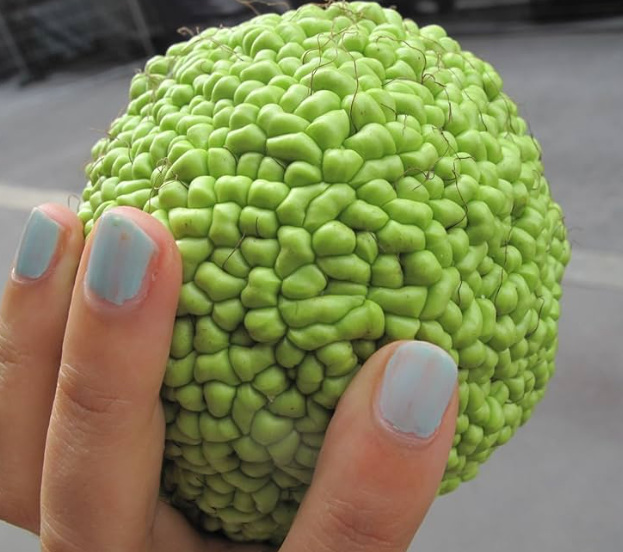
Squirrels and horses (it’s also known as a “horse apple”) are perhaps the only food-chain-fans of hedge apples. Squirrels are fond of a seed cluster found at their center, and so the neighborhood back yard tree line was full of them (you know, “Nibble, nibble, nibble. Poop! Poop!”). Seagy and his pre-school playmates were often envious of the neighborhood teenagers who were allowed to squirrel hunt, patrolling those tree lines with their Daisy and Red Rider BB guns.
Seagy’s next-door neighbors, Mr. and Mrs. O’Brien, had five daughters and a pet dog. They were all B’s. Parents Bob and Boots, daughters Barb, Bonnie, Betsy, Bobbie, and Belle, and pet dog — a Great Dane — Bomber. Bomber was as tall as the kitchen table and fittingly named. That dog could poop, and often did so in Seagy’s side yard, much to Dunk’s aggravation. Seagy didn’t mind so much. He steered clear of the side yard, ramming around along the three other sides of the house. Besides, he got paid a penny a poop to scoop Bomber’s droppings (later negotiated up to a nickel per poop). “Eat up, Bomber!” he thought.

Pet progressives, the O’Briens added a potbelly pig to the mix one summer. Named him Bacon. Bacon was a maladjusted little piggy and ironically would not eat. Having been off his feed for nearly a week, the O’Briens brought a couple of lab-coated, cowboy hatted “pigsperts” out to the suburbs for counsel. After a long confab, and several attempts to force feed him, Bacon left with the pigsperts, never to return. In later life, Seagy would come to feel a bit guilty for his enjoyment of certain breakfast meats.

One sunny summer afternoon with time to spare, Seagy found a sturdy empty cardboard box in the garage. Inspired by a slightly overblown friendship with the local postman, he had a great idea. Starting in front of his own house and walking left up the sidewalk, he stopped at every neighbor’s mailbox. Opening each mailbox, he removed the mail within. Letters, postcards, circulars, packages, newsprint, catalogs, bills, bank statements — all were tossed in his sturdy cardboard box which grew less and less empty at each stop. Left up the sidewalk half a block. Cross over W. 91st Street. Back down the sidewalk a full block. Cross back over W. 91st Street. Back up the final half block. Having emptied each and every mailbox, Seagy was once again back in front of his own house dragging a surprisingly heavy cardboard box. Very pleased with himself, Seagy showed his mother his collection. Considerably less pleased, Seagy’s mother was fairly horrified. Not stopping to research what the United States Penal Code said about five-year-old mail thieves, she emptied, sorted by family address, and rubber-banded the entire box full of U.S Mail, and gave each bundle to Seagy, twenty-nine in all, to be redelivered. She insisted Seagy make 29 separate deliveries. It took an hour and a half. Perhaps not surprisingly Seagy, after a full career as a hotel chain marketing exec, would begin his second career as a U.S. Postal Service letter carrier.
Seagy’s best friends were Tim and Willy Alexandrides, and their little brother Mikey (a.k.a., “Me-Too”). Mikey was always bringing up the rear as the brothers Alexandrides moved about the neighborhood. If a neighborhood mom offered them a refreshment, Tim would exclaim “Yes ma’am!” Willy would cheer “Thank you!” and Mikey would squeak “Me, too!” So, the nick name stuck.

To a family-member, the Alexandrides were accomplished western equestrians. Quarter-horse cutters, barrel racers and bull-doggers from cattlemen stock (by way of Greece way back there somewhere), they rode every year in the locally televised Kansas City Thanksgiving Day Parade. Their family den – a great room with a vaulted ceiling and exposed rough-hewn beams that emptied onto a grand semi-circular patio with a border hedge – was full of trophy hardware most of which was spread across a 10-foot-long live edge hewn plank mantle that accented their stone hearth. Saddles, bridles, chaps, stirrups, lariats, cowboy hats, and riding crops – many of which were finely detailed in turquois, silver and intricate leather work – wall-mounted and on display.
The Alexandrides boys had an impressive swing set situated in a big backyard surrounded by a split rail fence that got a lot of use. The four boys would all take turns swinging, two at a time, back and forth, higher and higher, at last letting go to sail through the air. Imagining themselves U.S. Army paratroopers, they would land with a thud and roll a few yards for effect. Each tried to outdistance the others, and to spice things up, the non-swingers would station themselves beside the imaginary drop zone each with a Ranch-Mart dime store bow and quiver full of suction cup arrows. To improve projectile aerodynamics, airspeed and accuracy, the suction cups were temporarily removed. Aiming carefully, moving back and forth in sync with their swinging targets, leading the targets slightly, the archers would wait for separation as their targets took flight, and then loose their arrows. In fact, all four in this merry band were hit. Many times. But no one poked their eye out.
Sensibilities back then were less finely tuned, you see.

Summers were always full of adventures, but those were interrupted daily by Tim, Willy and Mikey’s nap regimen. For Seagy, their summertime siestas were ninety minutes of lost opportunity. Impatiently waiting for his mates to rise from their midday slumber and not subject to the nap-rule himself, Seagy often hung out in the back yard of casa Alexandrides. One day, after climbing their tree, then swinging a while on their swing set, he meandered ever closer to the house, and while poking around on their patio he, discovered the back sliding door was unlocked. “Hmm. Well, well. What have we here?” Seagy mused. He slid the door open quietly and stepped inside, listening, keeping statue still, and then tip-toed down the hallway toward the boys’ bedroom, heart pounding, ears ringing, palms starting to sweat. Sure enough, there they were, sound asleep. Something creaked, and Seagy made a quick and slick exit, closing the slider behind him. In fact, Seagy would play cat-nap-burglar several more times that summer, not once being discovered. This fact would accidentally come to light one evening at dinner – a fact about which Dunk was none too happy.

The three Alexandrides were often in trouble, caught almost daily in some transgression. They would dash through the den, out the slider, onto the semi-circular patio, breaking hard to the right or left for one of two hedge openings into the back yard, then bee-lining it to the fence through or over which their chances of escape improved significantly. Shrieking in maternal “how many times have I told you not to do that” indignation, mother Alexandrides was instantly in hot pursuit.

Mother A. raced the three fraternal offenders into the den, bounding through the sliding glass door, and out onto the patio at a full sprint. She instinctively grabbed a finely crafted riding crop from a hook by the sliding glass door frame. As expected, the boys randomly banked left or right, hoping to confuse her, trying to get through the hedge breaks, turning up field for the back fence. No matter. Rivaling any steeple chase Olympian, Mother A. took just two more bounding steps, vaulted over the hedge past several saplings planted here and there, and was on those boys like a heat seeking mother-missile. Two sweaty heads under her left arm, and the third head’s shirt or scalp gripped tightly in her left fist, she lovingly applied the crop of education in her right hand to each of their seats of knowledge.
Sensibilities back then were less finely tuned, you see.
 WheeledWords